North Star Metrics get picked in a hurry and regretted at leisure. A team needs “one number to rally around,” someone suggests signups or pageviews, everyone nods, and six months later the metric is going up while the business is going nowhere. The problem is rarely the idea of a North Star — it’s choosing one that measures activity instead of value. A good North Star Metric captures the moment your product actually delivers on its promise. A bad one just measures motion.
This guide explains what a North Star Metric really is, how to tell it apart from a vanity number, and how to choose one that holds up.
What Is a North Star Metric?
A North Star Metric is the single measure that best captures the core value your product delivers to its users. It sits above the dozens of metrics you track day to day and answers one question: are we delivering more real value over time?
The keyword is value. A North Star isn’t your revenue, and it isn’t your traffic. It’s the leading indicator that, when it grows, revenue tends to follow because customers are genuinely getting what they came for. Spotify’s is time spent listening. A messaging app’s might be messages sent between connected users. Each one measures the product doing its actual job.
A North Star Metric measures delivered value, not activity. If it can rise while your customers get nothing more useful, it’s the wrong metric.
North Star vs Vanity Metrics
The fastest way to understand a North Star is to contrast it with the vanity metrics it’s meant to replace.
| Vanity metric | Why it misleads | Value-based alternative |
|---|---|---|
| Total signups | Counts intent, not value received | Activated users (reached first value) |
| Page views | Rises with confusion as easily as interest | Core action completed |
| Total registered users | Never goes down, hides churn | Weekly active users doing the core action |
| App downloads | Says nothing about use | Users reaching a meaningful outcome |
Notice the pattern. Vanity metrics count things that feel like progress but can climb while value stays flat. A value-based metric only moves when a user actually gets something. That’s the line your North Star must land on the right side of.
How to Choose a North Star Metric
A reliable North Star meets three tests. Run any candidate through all three before you commit.
1. Does It Measure Value, Not Activity?
Ask whether the metric can rise without your customers being better off. If yes, it’s activity. “Reports generated” goes up when the tool is confusing and people retry. “Reports successfully shared” only goes up when the job gets done. Pick the one that can’t be gamed by failure.
2. Does Growth in It Predict Business Growth?
A true North Star is a leading indicator of revenue and retention. If the metric climbed 30% this quarter, would you confidently expect healthier revenue to follow? If the link is fuzzy, keep looking. The whole point is that moving the North Star moves the business.
3. Can Teams Actually Influence It?
The metric has to be something product, marketing, and engineering can move through their work. A number nobody can affect is a poster, not a North Star. The best ones decompose into input metrics each team owns — which is where the real operating leverage lives.
Input Metrics: Where the Work Happens
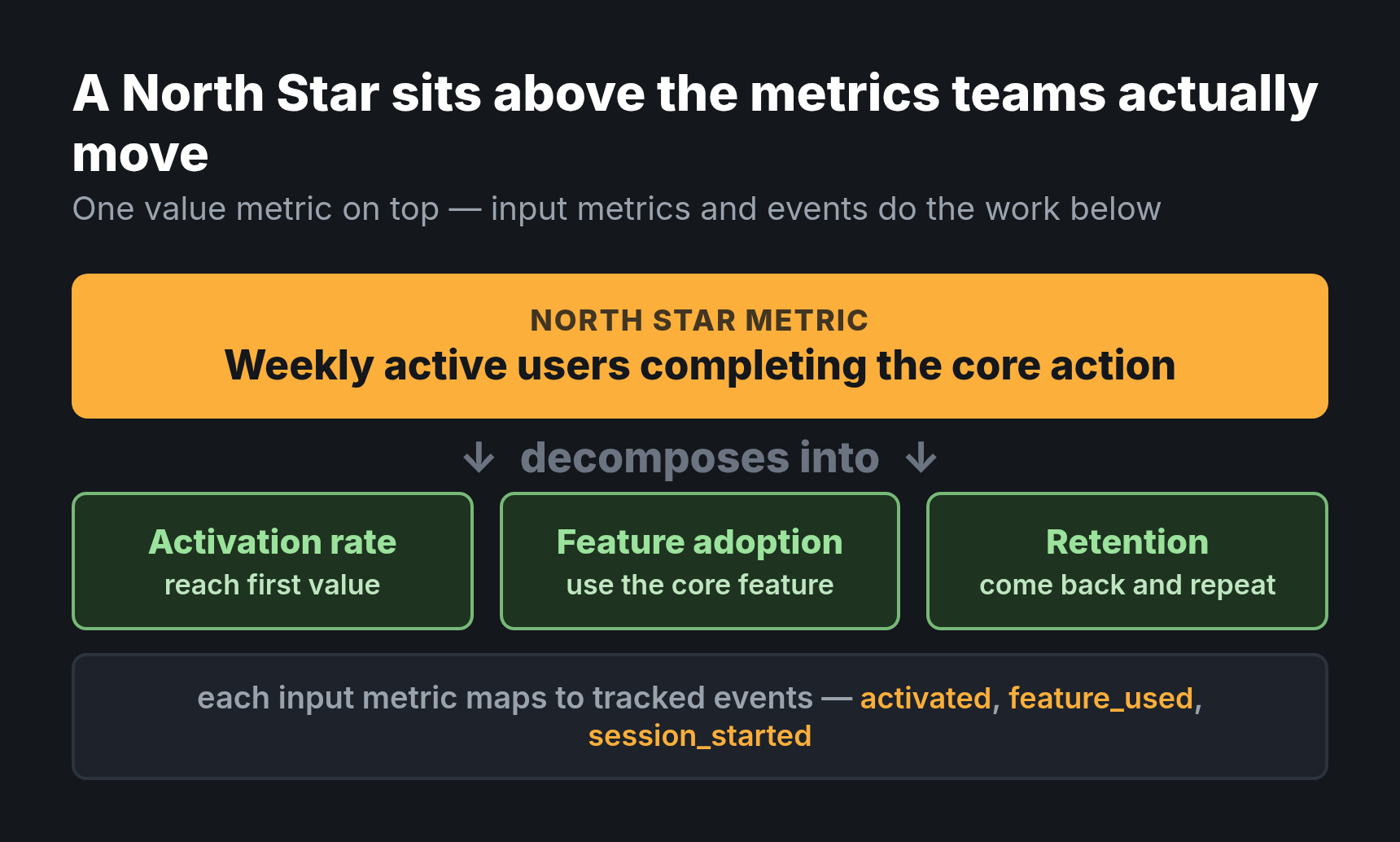
Your North Star is one number, but you don’t optimize it directly. You break it into the handful of input metrics that drive it, and teams work on those. If your North Star is “weekly active users completing the core action,” its inputs might be activation rate, feature adoption, and retention — each a lever a team can pull.
This structure keeps the North Star honest and actionable at once. The top number tells you whether value is growing; the inputs tell you how to grow it. It pairs naturally with a clear measurement plan so every input metric maps to events you actually track.
Common Mistakes
- Choosing revenue as the North Star. Revenue is the outcome, not the leading indicator. It tells you what already happened, not what value you’re building now.
- Picking a metric that only goes up. Cumulative totals like “all-time users” hide churn and can never signal a problem.
- Optimizing the North Star directly. Teams move input metrics; the North Star is the score, not the play.
- Never revisiting it. As the product matures, the metric that best captures value can change. Review it, but don’t change it on a whim.
FAQ
Can a company have more than one North Star Metric?
Generally, no — the discipline comes from picking one. Large companies sometimes run a North Star per product or business unit, but a single team rallying around two competing numbers usually just dilutes focus.
Is revenue a good North Star Metric?
Rarely. Revenue is a lagging outcome, not a leading indicator of value. A good North Star predicts revenue by measuring the value that causes it, so you can act before the revenue shows up.
How often should we change our North Star?
Seldom. Stability is part of its value — constant changes destroy the focus it’s meant to create. Revisit it when the product fundamentally shifts what value it delivers, not because a quarter looked flat.
What’s the difference between a North Star and a KPI?
A North Star is the one metric capturing core value across the company. KPIs are the many specific targets teams track. Your North Star usually sits above a structured set of input KPIs that feed it.
The Bottom Line
A North Star Metric is only as good as the value it measures. Choose one that captures the moment your product actually helps someone, that predicts business growth, and that teams can move through real work — then break it into input metrics where the optimizing happens. Avoid the trap of rallying around signups, pageviews, or revenue, all of which can climb while customers get nothing better. Get the North Star right and every team finally pulls in the same direction. Get it wrong and you’ll optimize motion for a year before anyone notices nothing moved.