Pseudonymization vs Anonymization: What GDPR Requires for Analytics
 Lukas Meier
·
·
6 min read
Lukas Meier
·
·
6 min read

Pseudonymization and anonymization get used interchangeably in analytics meetings, and that confusion is expensive. The two terms have precise, legally distinct meanings under the GDPR — and getting them wrong is how teams convince themselves they’re “anonymous” while still processing personal data under a different name. The line between them decides whether the GDPR applies to your event data at all. So it’s worth getting right.
This reference explains what each term actually means under EU law, why nearly all “anonymous” analytics is really pseudonymous, and how to decide which you need.
The Core Distinction
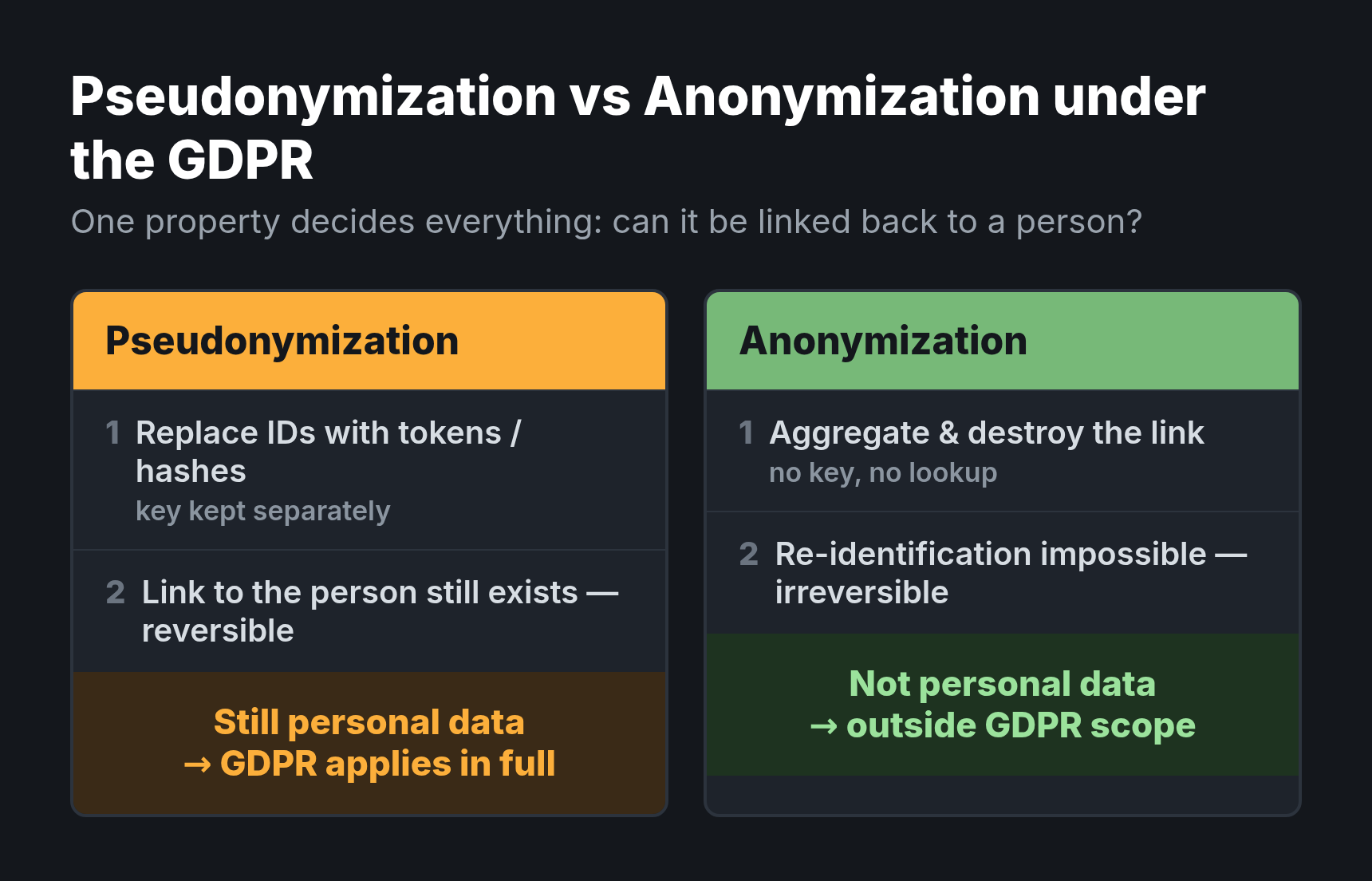
The difference comes down to one question: can the data ever be linked back to a person again?
- Pseudonymization replaces identifying fields with tokens, but the link to the person still exists somewhere — in a separate key, a lookup table, or additional data held apart. It is reversible by design.
- Anonymization destroys that link irreversibly. No key, no lookup, no realistic path back to the individual. It cannot be undone.
That single property — reversibility — is what the law hinges on. Pseudonymized data can be re-identified by someone with the key. Truly anonymized data cannot be re-identified by anyone, including you.
What the GDPR Actually Says
The GDPR defines pseudonymization in Article 4(5): processing personal data so it can no longer be attributed to a specific person without the use of additional information, provided that additional information is kept separately and secured. Crucially, the regulation treats pseudonymized data as still personal data. The GDPR applies in full.
Anonymization is addressed in Recital 26, which states that data protection principles do not apply to anonymous information — data that does not relate to an identifiable person. Once data is genuinely anonymized, it falls outside the GDPR entirely. But the bar is high: the recital asks you to consider “all the means reasonably likely to be used” to re-identify someone. If re-identification is reasonably possible, it isn’t anonymous.
Pseudonymized data is still personal data — the GDPR applies. Anonymized data is not personal data — the GDPR does not apply. Everything downstream follows from that one fact.
Pseudonymization vs Anonymization at a Glance
| Property | Pseudonymization | Anonymization |
|---|---|---|
| Reversible? | Yes, with the key | No, irreversible |
| Still personal data? | Yes | No |
| GDPR applies? | Yes, in full | No (out of scope) |
| Legal status | Security measure (Art. 32) | Outside GDPR (Recital 26) |
| Typical methods | Hashing, tokenizing user IDs | Aggregation, irreversible removal |
| Re-identification risk | Real if key is exposed | None, if done correctly |
Why Most “Anonymous” Analytics Is Actually Pseudonymous
Here is the trap I see most often. A team hashes the user ID, truncates the IP address, and declares the dataset “anonymized.” It isn’t. Hashing is a reversible mapping — the same input always produces the same hash, so it still functions as a persistent identifier. That’s pseudonymization, not anonymization.
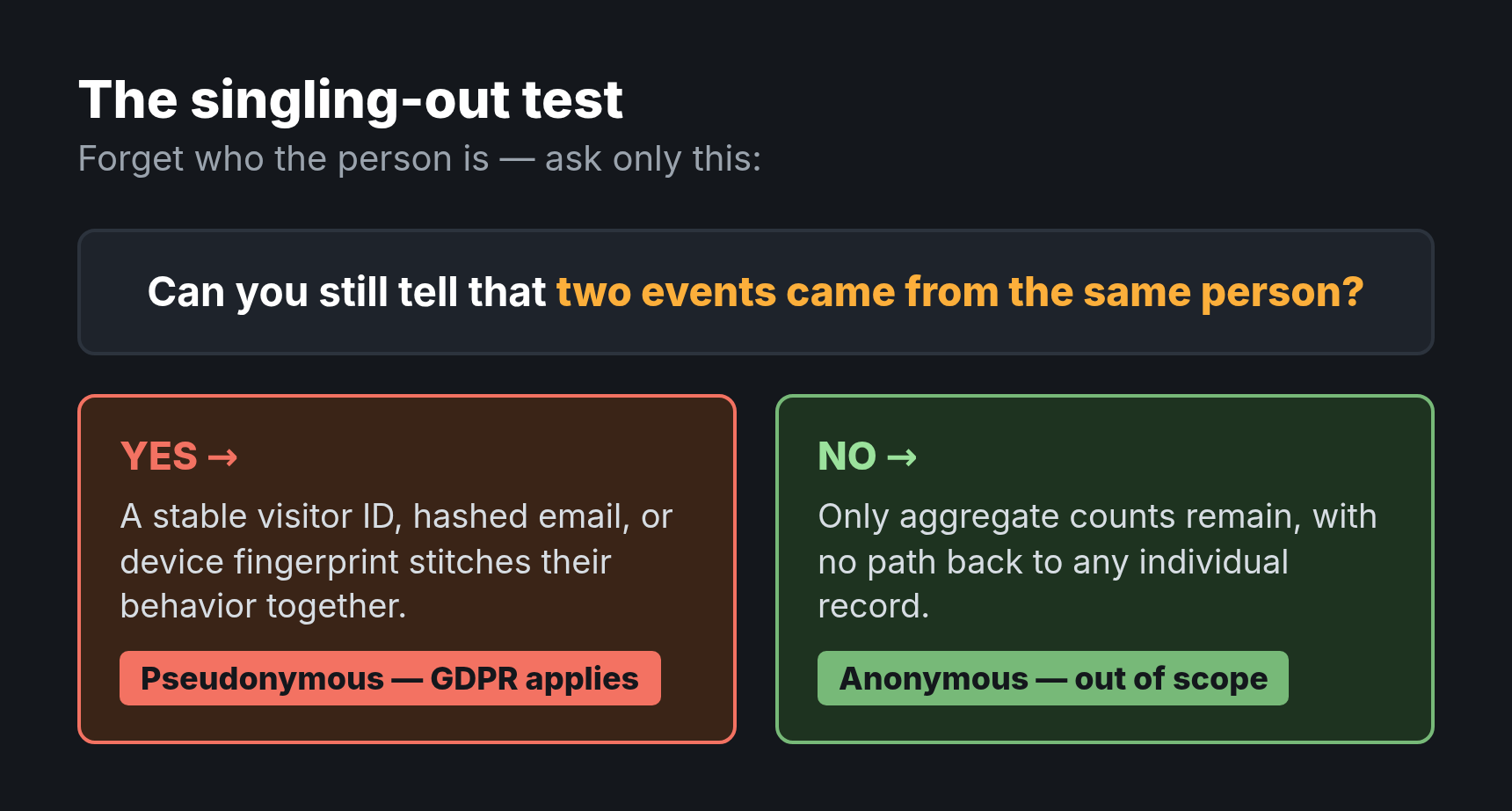
The test is simple. If you can still tell that two events came from the same person — even without knowing who that person is — the data is pseudonymous. A stable visitor ID, a hashed email, a device fingerprint: all of these let you stitch a single person’s behavior together. Therefore, the GDPR still applies, and you still need a lawful basis. This is the same reasoning behind our guide to GDPR-compliant event tracking.
When Data Becomes Truly Anonymous
Anonymization usually means aggregation. Once you collapse data into counts — “412 users completed onboarding in Germany this week” — and remove any path back to individual records, re-identification becomes impossible. The individual rows are gone, not just masked. That aggregate report is genuinely outside the GDPR.
Which One Do You Need?
The answer depends on what you’re doing with the data.
- Use pseudonymization when you need person-level analysis — funnels, retention, cohorts. You can’t measure Day-7 retention on truly anonymous data, so you keep it pseudonymous and rely on a lawful basis plus strong key separation.
- Use anonymization when you only need aggregates — dashboards, trends, public reports. If no downstream use requires individual records, anonymize and step outside GDPR scope entirely.
In practice, most product analytics lives in the pseudonymous middle. That’s fine — it just means you must treat the data as personal data, document your lawful basis, and protect the key as if it were the crown jewels, because legally it is. A solid privacy audit should confirm exactly where each dataset sits.
Common Mistakes
- Calling hashing “anonymization.” A hash is a reversible, stable identifier. It is pseudonymization, full stop.
- Storing the key alongside the data. Pseudonymization only counts if the additional information is kept separate and secured. Same database, same breach.
- Assuming aggregation is automatic. Small cohorts can still be re-identified. A “count” of one person is not anonymous.
- Treating IP truncation as a free pass. Truncating the last octet reduces risk but rarely achieves true anonymization on its own.
FAQ
Is pseudonymized data exempt from the GDPR?
No. Pseudonymized data is explicitly still personal data under Article 4(5). The GDPR applies in full. Pseudonymization is a recommended security measure that reduces risk, not a way to leave the regulation’s scope.
Does hashing a user ID make it anonymous?
No. Hashing is deterministic and reversible in effect — the same ID always yields the same hash, so it remains a persistent identifier. It is pseudonymization. To anonymize, you must remove the ability to single out an individual entirely.
Can analytics ever be fully anonymous?
Yes, but usually only at the aggregate level. Once data is collapsed into sufficiently large counts with no path back to individual records, it can fall outside the GDPR. Person-level analysis like retention or cohorts cannot be done on truly anonymous data.
Is pseudonymization required by the GDPR?
Not strictly, but Article 32 names it as an appropriate technical measure for securing personal data, and regulators view it favorably. It lowers breach risk and demonstrates a privacy-by-design posture.
The Bottom Line
Pseudonymization and anonymization are not two words for the same thing — they sit on opposite sides of the GDPR’s scope. Pseudonymized data is still personal data, so the regulation applies and you need a lawful basis and careful key separation. Anonymized data is no longer personal data and leaves the GDPR behind, but it’s far harder to achieve than masking a few fields. Most analytics is pseudonymous whether teams admit it or not. Name it correctly, treat it accordingly, and you avoid the most common compliance self-deception in the industry.

Lukas Meier
Product Analytics Specialist with 10 years of experience configuring tracking for e-commerce and SaaS products across Europe. Creator of EU-Medin.
more →